
Police stops and Bußgeld are a real system in German Moped Days. What is confirmed, what likely triggers a fine, and when the cheap-fines pass pays.
German Moped Days Police Fines: How to Avoid Bußgeld
German Moped Days has police, and the store proves they cost you money: one of the sixteen passes is called Billigere Bußgelder, which is German for cheaper fines. That is the developer confirming a system most players discover the hard way, usually on a tuned moped at the worst possible moment.
No fine amount, trigger list or cooldown has been published. This page covers what is confirmed, what the German moped rules the game borrows from actually say, and how to ride so a stop costs you a minute instead of a job chain.
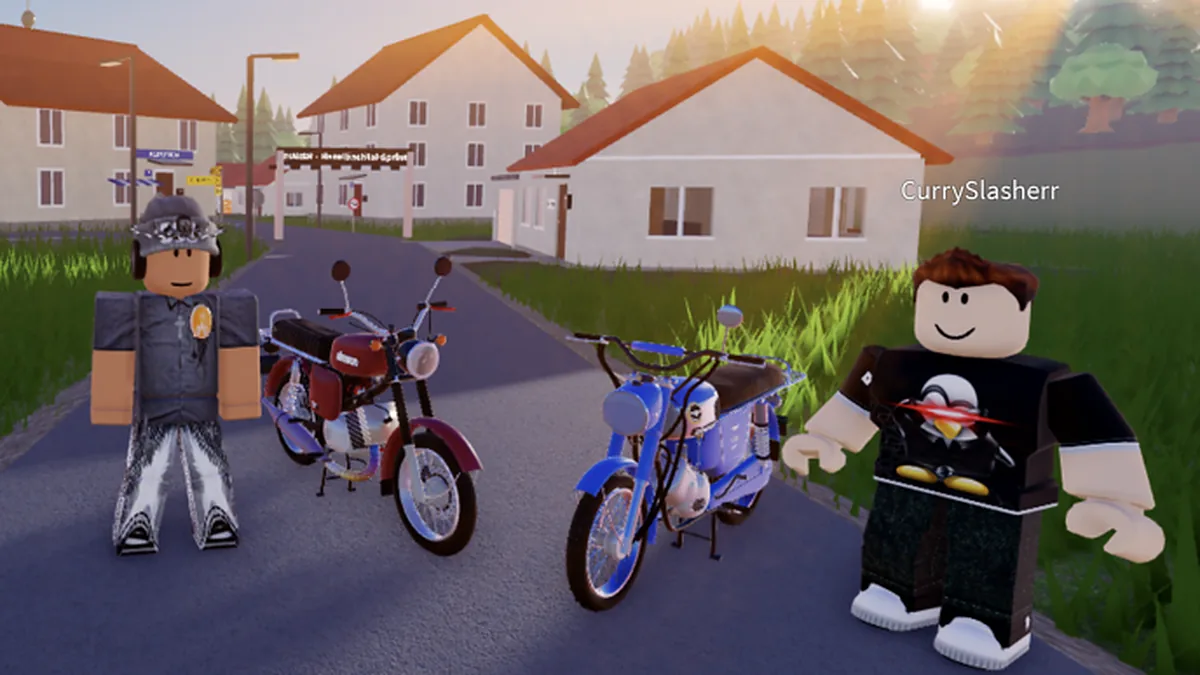
Official source: German Moped Days on Roblox — official media shows a police officer, checked October 29, 2026.
What is confirmed
Three facts, and they are enough to plan around:
- Police exist in the game world. The official media set includes an officer in uniform with a badge, standing next to two mopeds on a village street.
- Fines cost euros. The pass Billigere Bußgelder makes fines cheaper, which only makes sense if there is a fine to pay.
- Fines are frequent enough to insure against. A developer does not sell a discount on a rare event.
Everything beyond that, including how much a fine costs, is inference. Treat any page quoting exact numbers as a page that made them up.
What the German rules borrow from
The game is not a law simulator, but its setting explains why police are in it at all. Real German moped law is unusually bureaucratic, and three parts of it map onto game mechanics:
The insurance plate (Versicherungskennzeichen). Every moped on a German road carries a small insurance sticker, renewed annually, colour-coded by year. Riding without one is the classic roadside stop. A game that models plates, fines and police has an obvious reason to model this.
The driving licence class. A German moped up to 25 km/h needs a Mofa-Prüfbescheinigung; the faster 45 km/h class needs AM. The distinction matters because a moped that has been tuned past its class is, in real life, no longer the vehicle its papers describe.
Tuning and legality. This is the part the game almost certainly leans on. In Germany, changing a moped's exhaust, carburettor or gearing can void its type approval and its insurance. A tuned moped is exactly what a patrol would stop, and German Moped Days sells tuning and police fines as two systems in the same game.
We could not confirm the trigger list, but the pairing is hard to miss: the store sells tuning parts and a discount on fines. If you build a loud, fast bike, ride it like the police are looking, because in this game they probably are.
How to keep a fine from ruining a session
The fine itself is not the expensive part. The expensive part is what a stop interrupts.
- Never carry your whole balance. Keep one job chain's worth of euros in reserve. A fine that leaves you unable to refuel is a fine that ends your session.
- Ride the speed limit. If the game models a 50 km/h sign, as the official Puch screenshot shows, it models a reason for one.
- Keep the bike legal-looking. Stock exhaust, stock gearing, working lights. A quiet bike draws less attention than a build with underglow and a straight pipe.
- Do not run a job chain through a village centre at speed. Job routes that stay on the edge of town are faster and less exposed.
- Fill up before a long chain. A moped that dies at the roadside is a moped the police find stationary.
None of that is confirmed mechanics. It is the behaviour the game's systems reward, based on what the store and the official screenshots show.
Is Billigere Bußgelder worth buying?
The pass reduces fines, so the maths is simple: how often do you get fined, and how much does a fine cost?
- If you ride stock and carefully: you may never trigger a fine. The pass saves nothing.
- If you ride a tuned build through town: fines are a running cost, and a discount on a running cost pays back over time.
- If you are new: buy fuel and parts first. The money guide ranks the passes by first payback, and cheap fines sit in the middle tier for a reason.
The pass is insurance, not a cure. It does not stop the stop, it only makes the receipt smaller, and a stop still costs you the minutes you spent pulled over.
Tuning, police and the risk trade
The tuning guide covers Jlows Tuning-Werkstatt and the one-to-twenty-minute queue. What it cannot tell you is whether a specific part raises police attention in game, because that is not documented.
Two ways to handle the uncertainty:
- Tune for reliability first. Brakes, tyres and suspension make you faster over a route without making the bike louder. If attention is tied to visual or audio cues, a quiet functional build is the safe version.
- Tune for performance and budget for fines. If you want the loud build, treat Billigere Bußgelder as part of its cost, the same way you treat fuel.
Either way, do not tune a bike you cannot afford to lose for a session. The mopeds page covers resale and garage slots if you want a second bike for the risky riding.
A five-minute check before you ride
The cheapest fine is the one you never get. Before a job chain:
- Lights and plate. If the game renders them, they are probably checkable. A dead light is the kind of thing a patrol notices.
- Exhaust sound. A stock pipe is quiet. If your build is loud enough that you notice it, a patrol might too.
- Fuel and oil. A stopped moped is an easy target and a lost chain.
- Balance. Keep one job's worth of euros spare, so a fine costs you profit rather than the session.
- Route. Prefer the edge of town to the centre. Fewer stops, fewer chances.
None of these are confirmed triggers. They are the habits that make the confirmed system cheap to live with.
What we could not verify
- Fine amounts. Not published anywhere official.
- What triggers a stop. Speed, tuning, collisions and random patrols are all plausible; none is confirmed.
- Whether fines escalate. Unknown whether a second stop costs more than the first.
- Whether the pass discounts all fines or a subset. The name says cheaper fines, not free fines.
- Whether police can impound a moped. No evidence either way.
If a page gives you a fine table with exact euro amounts, it invented them. The honest state of knowledge is a system that exists, costs money, and can be discounted.
FAQ
Do police give fines in German Moped Days? Yes. The store sells a pass that makes fines cheaper, and the official media includes a police officer in uniform.
How much is a fine? Not published. No official source lists an amount, so treat any exact figure as a guess.
How do you avoid police fines? Ride a legal-looking stock bike, keep to the speed limit, and avoid tuned exhausts if attention is tied to builds. Keep a cash buffer so a stop cannot end your session.
What does Billigere Bußgelder do? It makes police fines cheaper. It does not prevent stops, and the discount amount is not published.
Can you get arrested or lose your moped? No evidence of either. The confirmed consequence is a fine you pay in euros.
Is a tuned moped more likely to be stopped? Unconfirmed, but the game sells tuning and fine discounts side by side, which suggests the two systems interact.
Read the tuning guide before you build a loud bike, or go back to the German Moped Days hub for the full guide set.