German Moped Days Mopeds: Which One to Buy First
The Simson S51 and Puch Maxi S are the two mopeds confirmed in German Moped Days. What each is for, how buying and resale work, and what to check.
German Moped Days has no published moped list and no stat sheet. There is no official wiki, no dealer catalogue and no comparison table from the developer. What exists is official screenshots showing two models clearly, a store built around buying, selling and storing mopeds, and a garage that starts with three slots.
So this page does what the game does not: it identifies the two confirmed mopeds, explains the real-world machines they are based on, and gives you a buying process that works without a stat table.
Official source: German Moped Days on Roblox — official media shows both models, checked October 29, 2026.
The two mopeds shown in official art
Only two models appear in the developer's own screenshots, both repeatedly:
Simson S51. Shown in yellow at a fuel station and in blue-violet at a Tankstelle with the shop sign "B 85" behind it. It is the more substantial-looking bike in the art: a full frame, a visible engine case stamped ZSCHOPP, a chrome exhaust running low along the right side, and a tank badge. In the real world the S51 was built in Suhl in East Germany from 1980 to 1991, a 50cc two-stroke with a three-speed manual gearbox, and it is the moped that German reunification nostalgia is built on.
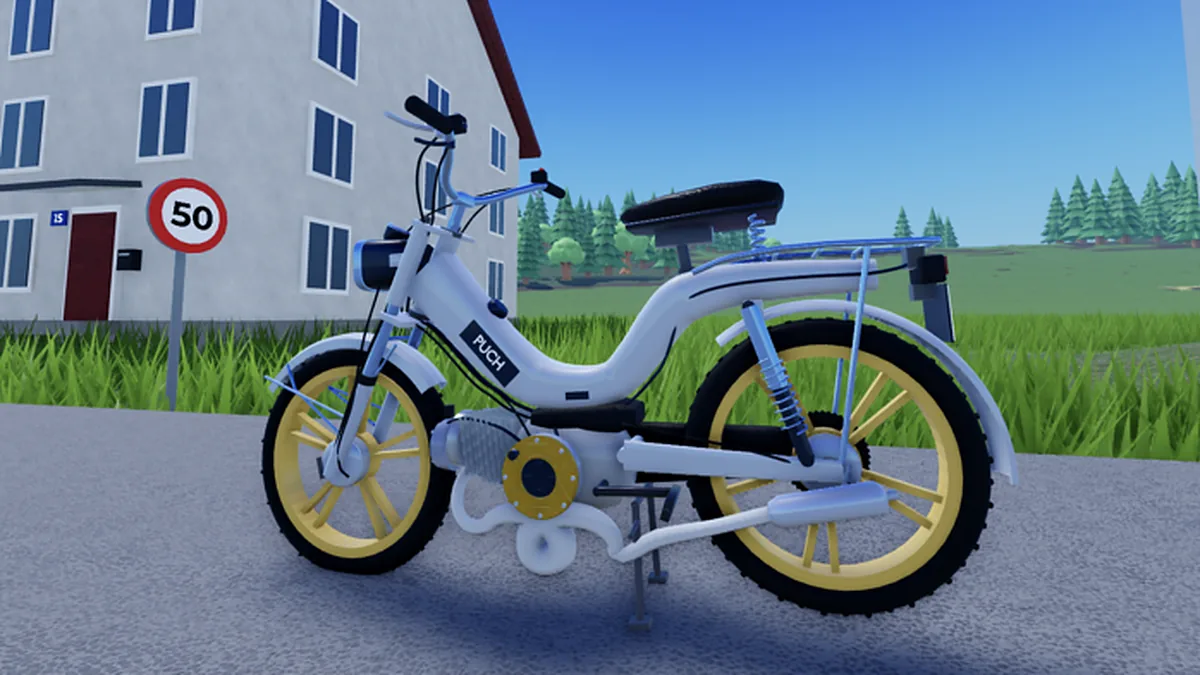
Puch Maxi S. Shown in white with gold rims, parked next to a round 50 km/h sign on a village street. The real Maxi was Austrian, a 49cc single-speed automatic from the 1970s, and its frame shape is unmistakable: a step-through top tube, a small tank under it, and an engine hanging below the frame with a cover.
Those differences are heritage, not verified game stats. The game may model gearboxes, top speed and handling differently. What the art does tell you is which bikes the developer considers the visual core of the game, and those are the two you will see most often in the shop and on the road.
Buying a moped without a stat table
The store page confirms three purchase mechanics: buying a moped, upgrading garage slots, and reselling with better prices through the Verhandlungs Profi pass. The parts shop and tuning workshop are separate systems that sell upgrades for whatever you already own.
A buying process that works around the missing data:
- Buy the cheapest bike you can fully fuel. Not the fastest. A bike with an empty tank and no oil is a static prop with a price tag.
- Price the first service into the purchase. Fuel, oil and one functional part. If the total exceeds your balance, the bike is too expensive for you today.
- Test it before you upgrade it. Ride one job route on the stock bike. The route tells you whether the problem is the bike or the rider.
- Only then buy parts. The tuning guide covers the workshop wait; the parts shop is where the money actually goes.
A moped that reaches the job board, the station and the garage without a refuel is faster than a faster moped that needs one. In a game with two tanks and a delivery timer, reliability beats top speed every session you actually play.
Garage slots and what they are for
The garage starts with three slots. The store sells three expansions: Bigger Garage (+3), Bigger Garage 2 (+3), and Unlimited Garage, which removes the limit.
Three slots is a design statement. The intended arc is not one perfect bike, it is a small fleet:
- A daily rider for jobs, cheap to run and not tuned to the edge.
- A project for tuning at Jlows, which sits in the workshop for one to twenty minutes at a time.
- Something to sell, bought cheap and moved on with the negotiation pass.
If you only ever own one moped, you do not need a garage pass, and buying one is a waste of Robux. If you own four, Unlimited Garage is the only expansion that stops being a repeating purchase.
Resale, and why Verhandlungs Profi exists
The pass description is explicit: mopeds cost less to buy and sell for more. That is a resale margin, and a resale margin only exists if the game has both a shop price and a player-facing sale price.
Two honest limits: the developer has not published the margin, and we could not test it without an account. What we can say is what the pass implies about the economy. If resale were a trivial round trip, nobody would buy a pass for it. The margin is meant to be thin enough that the pass matters and thick enough that trading is worth doing.
For a first purchase, ignore resale entirely. Buy the bike you will ride. Come back to trading once you have a route and a spare slot.
What to check before you pay
No stat sheet means you check the bike, not the listing:
- Tank state. Empty tank means an immediate extra cost. Ask yourself whether the price already includes it.
- Engine and exhaust condition. Parts wear and the tuning workshop exists to replace them. A bike with a damaged exhaust is a bike with a hidden bill.
- Slot availability. A fourth moped with three slots is a moped you cannot store. Check the garage before the shop.
- Whether the model appears in official art. If a listing shows a bike the developer has never shown, it is either new or a reskin. New is fine; buy it knowing nobody has written about it yet.
- Your total balance after the purchase. Keep one job chain's worth of euros in reserve. The first fine or breakdown arrives when you have nothing left.
What we could not verify
Being clear about the gaps is more useful than filling them:
- Top speed, acceleration and handling per model. Not published. Any page with a speed table is estimating.
- Moped prices. Not published on the public API, and the shop rotates temporary discounts that change the effective price.
- Whether the Puch is automatic and the Simson manual in game. True of the real machines; unconfirmed in-game.
- How many models exist in total. The art shows two. The shop may list more.
- Whether upgrades carry over on resale. Unknown, and it changes the maths on tuning a bike you plan to sell.
If you find a page quoting exact horsepower or a full moped tier list for this game, it is writing fiction with confident formatting.
FAQ
How many mopeds are in German Moped Days? At least two are confirmed by official art, the Simson S51 and the Puch Maxi S. The developer has not published a full list.
Which moped should I buy first? The cheapest one you can fully fuel and maintain, with enough left over for one repair. Speed matters less than a bike that can complete a job chain without a refuel.
How many mopeds can I own? Three by default. Bigger Garage adds three, Bigger Garage 2 adds three more, and Unlimited Garage removes the cap.
Can you sell mopeds? Yes. The Verhandlungs Profi pass explicitly makes mopeds cheaper to buy and worth more when sold, which confirms a resale market exists.
Are the mopeds based on real models? Yes. The Simson S51 is an East German 50cc two-stroke from 1980 to 1991, and the Puch Maxi S is an Austrian 49cc automatic from the 1970s.
Is the Puch Maxi S automatic in game? Unknown. The real Maxi is a single-speed automatic and the real S51 has a manual gearbox, but the game has not published per-model specs.
Read the beginner guide for the first purchase in context, or the tuning guide once you own a bike worth upgrading.